
Download the PDF.
Yet systems built to improve innovation capabilities now face an underrecognized burden: unmanaged complexity. Each new process or governance layer can inadvertently slow progress, diluting impact and obscuring where value is created. The very efforts meant to strengthen innovation instead weigh it down, and teams spend more energy navigating bureaucracy than creating value. Complexity is rising across every function in large organizations—strategy, operations, IT, and talent—and innovation is no exception.
That friction has become a central performance challenge. Organizations with lower levels of complexity report higher levels of innovation. Leaders can improve innovation performance by treating complexity as a design variable—adding practices with intent and pruning the friction those practices can unintentionally create.
How Complexity Undermines Innovation Systems
To improve the speed and quality of innovation, companies need to understand how organizational complexity emerges. Innovation work spans many moving parts—people, decisions, resources, and workflows—that depend on one another. As those dependencies grow, progress becomes harder to predict and easier to stall.
The result is coordination load: the effort it takes to keep everything aligned as ideas move from concept to impact. When handoffs, feedback loops, and approvals multiply, the system becomes harder to navigate. Small changes can create big ripple effects, and even minor friction starts to slow everything down.
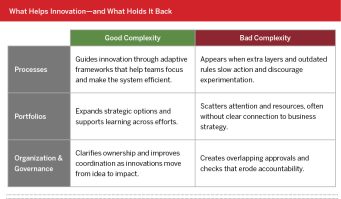
Complexity itself isn’t inherently bad. Some degree of it is essential, helping organizations reduce uncertainty and make better decisions. The challenge for leaders is recognizing when complexity stops paying for itself.
Bad complexity emerges when layers of process, portfolio, and governance structures expand faster than their benefits. This shift often happens gradually, as approvals, meetings, and process steps accumulate in response to real issues. Over time, decision-making is slowed, accountability blurred, and the quality of innovation is reduced, creating a hidden tax on performance.
Complexity can be managed when leaders recognize it’s the result of choices, not an inevitable byproduct of growth. By making it visible and separating what drives progress from what gets in the way, organizations can intervene early and shape better outcomes. The four mindsets that follow offer practical ways to do that.
1. Make complexity visible.
Innovation processes are often well-documented, with polished slides and stage-gate diagrams that project order and control. But those artifacts rarely reflect how work actually gets done. Teams rely on workarounds and informal paths to keep things moving, applying “best practices” inconsistently as situations arise.
Addressing complexity requires shifting attention from how the process is designed to how work actually gets done. Leaders need a clear view of how innovation operates in practice, not just how it appears on paper. By surfacing interdependencies, redundancies, and friction points, organizations can see what is constraining progress.
 One practical way to build this visibility is through process mapping and decision audits, which use interviews and data to help teams trace how ideas move from concept to impact. A useful starting point is inventorying decisions that govern progress: who makes them, where they get made, and how long they take. Reviewing recurring forums and handoffs alongside those decisions often reveals duplicated governance and unclear decision rights.
Making complexity visible can be a wake-up call. When leaders compare the documented process to the lived experience, they can see where approvals add delay without value and where informal work has become essential to progress. This insight allows teams to simplify innovation systems and focus best practices on what moves ideas forward. The goal is to ground the system in reality and keep complexity in check instead of letting it quietly build up.
Questions to Explore:
- Where do familiar decisions or handoffs now routinely slow innovation?
- What is happening “backstage” that drives these slowdowns?
- What data or insights could help teams see the real constraints on performance?
2. Design local fixes with the whole system in mind.
When organizations try to improve innovation, they often focus on fixing specific pain points they see up close, tightening a process or refining a metric. Each fix seems sensible, but without visibility into the impact on the broader system, these changes can collide. Over time, local optimizations multiply into global dysfunction through issues such as conflicting processes and redundant oversight.
This dynamic shows up, for example, when organizations respond to bottlenecks by adding new governance bodies to speed decisions in one part of the innovation process. New structures often overlap with existing approval paths. Each performs well against its mandate, yet together they lengthen decision paths and blur ownership and accountability.
One technology organization we have worked with took this to an extreme. It created new governance bodies to solve real problems, like allocating investments for enterprise capabilities or lab space for innovation. Over time, each board stayed in place as new ones were added, creating a labyrinth of approvals that slowed momentum.
To prevent this, teams need to see innovation as an interconnected system rather than a set of isolated parts. Managing complexity well means considering how local changes affect the whole and ensuring everyone involved understands this. To make this practical, teams can conduct periodic innovation system “health checks” as well as assess system-level consequences before implementing tools, rules, or governance bodies. As conditions evolve, these prevent well-intentioned improvements from hardening into friction that drags down performance.
Questions to Explore:
- Which local improvements may be creating unintended costs or confusion elsewhere?
- How can leaders help teams consider the broader system before optimizing one area?
- Which past interventions are no longer relevant to today’s innovation efforts?
3. Embrace intentional subtraction.
Once leaders understand how complexity shows up in their innovation system, they gain an opportunity to intervene with intent. Instead of adding new mechanisms to address every challenge, they can step back and decide which existing elements still deserve to shape how work gets done. This kind of pruning sharpens focus and restores momentum without introducing anything new.
This matters because accumulated complexity quietly shapes day-to-day behavior. It influences how teams decide what to work on and how they judge progress, even when those cues no longer reflect current priorities. By narrowing what continues to guide action, leaders reduce the need for interpretation and alignment before teams can move forward.
An aerospace company we advised illustrates this. Over time, it had adopted three different customer segmentation models: a volume-based hierarchy, a vertical marketing segmentation, and a “jobs-to-be-done” framework. Each offered useful insights, but together they created conflicting signals about how to define and serve the customer. Teams were pulled in competing directions, trying to reconcile models. After recognizing this, leadership reduced the number of models and invested time to better map and explain how the revised frameworks could work together.
Subtraction works best when it becomes a deliberate, recurring practice rather than a one-time cleanup. As strategies evolve, elements that once helped the system can continue to shape behavior long after their usefulness fades. Revisiting what remains in place allows leaders to keep the innovation system focused on what matters now, rather than letting accumulated history determine how work gets done.
Questions to Explore:
- What parts of our innovation system have outlived their usefulness—but remain untouched?
- Where are we holding onto processes that serve leadership optics more than actual outcomes?
- Where would pruning low-impact activity free capacity for higher-value work?
4. Build a culture of complexity management.
Managing innovation complexity isn’t just about streamlining—it’s about building a culture that focuses on continuous improvement. One-time simplification efforts help, but they’re rarely enough.
For instance, an engineering company we advised added complexity to its innovation management models when it shifted from hardware to software-enabled offerings. For years, the company relied on a centralized stage-gate model, where senior leaders reviewed projects at fixed checkpoints to decide which ideas move forward. As software became central to the strategy, teams began adopting agile methods alongside this existing system to support faster iteration.
The result was a collision of models. Teams didn’t adopt a common version of agile. Some used scrum, suited to small, autonomous teams; others used SAFe, designed to coordinate across teams; still others combined elements of both. While the company prized discipline and predictability, it was less accustomed to questioning new innovation tools. Without a way to surface tradeoffs and align on how the system should evolve, the company struggled. Addressing this challenge required significant change management and cultural work to align and implement one common agile approach.
Developing this type of culture begins with shared understanding of complexity. When leaders build a common language for complexity, teams can spot it earlier, name it clearly, and address it. Routines such as after-action reviews or periodic process audits provide a practical check on whether change is adding value or creating unnecessary friction.
Metrics are equally important. Just as companies track innovation outputs like launch rates or new product vitality, measuring friction points can also improve overall innovation performance. Sustaining simplicity doesn’t mean resisting change. Some new practices should be added as business models evolve. As industrial companies shift from hardware to software or solutions, for example, their innovation systems must adapt. The goal is creating a culture that can flex with change while keeping complexity in check.
Questions to Explore:
- What leadership habits keep complexity visible in everyday work?
- How can teams develop the reflex to spot and reduce complexity as it emerges?
- Where can flexibility be built into current systems so they adjust as conditions change?
________
When leaders account for complexity in every aspect of innovation, best practices finally deliver what they promise: real performance and lasting impact. The goal isn’t to eliminate complexity but to understand it, manage it, and use it intentionally. By making complexity visible, balancing local and global needs, pruning what no longer adds value, and embedding these habits into the culture, organizations can restore clarity and momentum to their innovation systems, channeling energy back toward what matters most: creating value for customers and growth for the business.
About the Authors
Ned Calder is a Managing Director at Innosight, based in Boston. ncalder@innosight.com
Freddy Solis is a Senior Director at Innosight, based in Boston. fsolis@innosight.com