Download the PDF.
These choices go beyond enterprise strategy. They shape the priorities and operations of individual business units and critical functions like finance, where digital investments carry lasting implications. That’s why strategy matters more than ever. Leaders need a clear way to bring coherence to today’s high-stakes decisions and bridge them to a long-term vision, one that prevents the costly organizational complexity that comes from misaligned initiatives and scattered bets. That connection brings focus, revealing the true cost of inaction and helping companies choose where to play and how to win.
This is where future-back strategy makes a difference, connecting decisions and aligning people across an organization. It helps leaders define what a business needs to become to thrive, translating that vision into practical guidance for near-term, high-impact choices. With pressure mounting on companies to accelerate performance improvement, future back helps clarify where to focus, what to stop, and how to free up resources for investment capacity. It drives decisions about portfolios, cost structures, operating models, and what is required to meet the moment and own the future.
From Vision to Impact: Future Back Drives Outcomes
When leadership teams take a future-back approach, they anchor their strategy in the long-term forces shaping the business and translate that perspective into a sequence of near-term decisions. They begin with a total shareholder value analysis to see where value lies today and how growth and performance improvements could reshape tomorrow. That insight provides the foundation for identifying and framing the critical investments that will shape the enterprise over time.
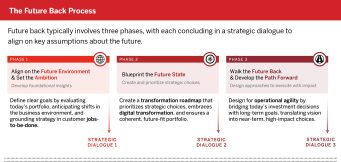
From there, leaders develop a shared view of the future environment, grounded in a deep understanding of customer jobs-to-be-done and the evolving market landscape. This view becomes a north star, providing clarity on the enterprise’s aspirations and path to competitive advantage. With that clarity, organizations can refocus the core business, reprioritize resources, and invest in capabilities required to realize their long-term vision, through both organic and inorganic growth. When companies take this disciplined, end-to-end approach, they gain:
- A compounding effect on progress. By refocusing the core and reallocating resources to well-chosen opportunity areas, companies generate momentum now and free up investment for what matters most, including acquisitions.
- Stronger leadership engagement. Involving leaders across the enterprise deepens their understanding of the strategy and builds commitment through active participation in the process.
- Real movement on execution. Progress takes shape through strategic capability building and operating model changes that create alignment, simplify complexity, and enable faster, smarter decision-making.
- Ownership of the strategic narrative. With a compelling, realistic view of the future, leaders can confidently communicate direction and trade-offs internally and externally.
Blueprints for Future-Back Transformation
These case studies demonstrate how leading organizations have harnessed future-back strategy to drive meaningful transformation across varied contexts. Though each faced unique challenges, consistent patterns emerge: a bold long-term vision guiding near-term priorities, sharper resource allocation aligned with strategic intent, and cross-functional alignment that accelerates execution with clarity and conviction.
1. Industrial group unifies growth strategy through platform model.
A family-controlled company with multiple businesses tapped an outsider as a CEO for the first time in its history and established an ambitious long-term growth goal. The problem: it had no clear path to get there. Future back enabled it to fully comprehend the gap between its ambitions and current growth trajectory, guiding the creation of a transformation roadmap to diversify its businesses by establishing more broadly enabled platforms for growth.
The Origins of Future-Back Strategy
Future-back strategy builds on decades of Innosight’s research and practice on innovation and growth. The concept was codified in the book Lead from the Future by Mark W. Johnson and Josh Suskewicz, which outlines how leaders can envision the future and work backward to build it. Today, future back has become a proven approach for connecting long-term vision to near-term decisions, applied across industries and contexts.
Future back also helped leadership develop a shared narrative for its new growth strategy, clarifying roles across the portfolio and replacing disconnected initiatives with coordinated investment decisions. Leaders began treating each business as a platform anchored in distinct capabilities and future-focused opportunity areas. That shift enabled a healthcare-focused acquisition to serve as the foundation for an additional platform, extending the company’s strategy beyond its historical core. Read more here.
2. Global retailer transforms cost pressures into a strategic advantage.
A global convenience store and fuel station operator faced rising labor costs and pressure on profitability driven by macro and industry-wide dynamics. To break from the pack and continue driving value creation, it needed to rethink how it delivered services that would be more relevant to the consumer jobs of tomorrow across thousands of locations. The company used future back to define a new vision for its retail model and determine how to reallocate resources to drive the necessary changes.
 Future-back discovery revealed opportunities to reimagine store formats as adaptable, tech-enabled hubs tailored to location-specific needs, enhancing the customer experience with charging stations for electric vehicles and other services. At the same time, it identified opportunities to leverage automation and other technologies to boost efficiency and reshape its cost structure.
The company is testing new retail formats and spaces and streamlining its cost base by centralizing administrative tasks and piloting digital tools, with expected labor savings of up to $500 million annually. By refocusing core operations and freeing up resources to reinvest in innovation, it is strengthening its leadership in mobility and retail. Read more here.
3. Healthcare provider redesigns for resilience through strategic, phased change.
A regional health system faced mounting labor costs and limited capacity, putting pressure on its ability to meet growing patient demand. Committed to large-scale transformation, the organization turned to future back to guide its path, linking urgent operational improvements to a broader vision for sustainable growth.
The approach helped it structure a series of initiatives across multiple time horizons. Near-term efforts focused on relieving immediate pressure, such as improving access to surgical services by eliminating scheduling bottlenecks. These were followed by medium-term investments that repositioned services system-wide and focused resources on high-growth areas. Longer-term, leaders applied data-driven patient routing to shift routine cases to secondary facilities, freeing the flagship hospital for complex care and building partnerships to deliver care in new channels.
The impact was both swift and measurable. New operational agility delivered millions of dollars in annual margin improvement, while future back ensured that each step built toward a unified transformation agenda. By aligning short-term wins with long-term ambition, the health system positioned itself to deliver better patient care with greater resilience. Read more here.
4. Tech giant transforms finance function into an enabler of strategy.
Explore how we help leaders align ambition with action to drive transformation.
To support its ambitions, the company sought to reimagine the finance function, pursuing a strategic shift in its role and operating model that would deliver the benefits of a digital transformation, not just a technology upgrade. Using future back, the company defined a bold vision for finance as a growth enabler, one that could deliver insight and speed at scale.
Working from that vision, the team redesigned core processes and implemented a modern digital platform, embedding AI-driven automation across workflows. Leadership aligned on finance’s expanded role, while teams embraced a culture of continuous improvement. The result: faster closes and real-time visibility, positioning finance as a true partner in business performance and long-term growth. Read more here.
________
At its core, future back is about turning strategic ambition into momentum and measurable impact. It connects long-term vision with the near-term decisions that bring it to life and equips leaders to make bold yet grounded choices, even under pressure, by aligning investments with strategic intent.
About the Authors
Rob Bell is a Managing Director at Innosight based in Boston. rbell@innosight.com
Ned Calder is a Managing Director at Innosight based in Boston. ncalder@innosight.com
Shahriar Parvarandeh is a Senior Director at Innosight based in London. sparvarandeh@innosight.com